Wednesday, January 21, 2009

I Can Learn Welsh in a Week

I Can Learn Welsh in a Week
by James McCarthy, Wales On Sunday
http://www.walesonline.co.uk/news/wales-news/2009/01/25/i-can-learn-welsh-in-a-week-91466-22770786/


AN AUTISTIC man who picked up Welsh from road signs and children’s books during a two-week holiday has boasted: “I could learn it in a week.

Genius Daniel Paul Tammet hopes one day to speak at the Eisteddfod and perhaps even win the coveted learner’s prize.

The linguist and writer, who lives in Avignon, in the south of France, discovered the tongue when he visited Blaenau Ffestiniog for a break in Snowdonia.

Mr. Tammet, 29, a Londoner, also has synaesthesia, which can affect language learning.
He said: “I saw the road signs in Welsh and saw all the public conveniences were in Welsh and it struck me as a beautiful language. I was told that was where Welsh was spoken widely, where it really thrived. So I got a dictionary and bought some children’s books in Welsh and read them, and enjoyed them.”

Mr. Tammet has also taught himself French, Finnish, German, Spanish, Lithuanian, Romanian, Estonian, Icelandic and Esperanto. He has also invented his own language called Mänti.

He said it took him “not very long” to pick up Welsh during his visit.
He managed to learn Icelandic against the clock in a week for a Five documentary.

“In terms of Welsh it was little by little,” he said. “Every time I got hold of a Welsh person I would tease out as many words as I could. People are always frightened of a language like Welsh because it looks and sounds so different.

“But there is a lot in it that’s not so different. There is a lot of beauty in there and logic. It’s just a different kind of logic.

“There’s no reason why I could not pick up Welsh as quickly as I did Icelandic. It’s a case of exposure. ”

Ffred Ffrancis, of Welsh Language Society Cymdeithas yr Iaith Gymraeg, said: “I’ve no idea about his system of learning, but it exemplifies that it’s no big deal learning a language and we should overcome the mental block in Wales and Britain about other languages.”

Aran Jones, chief executive of fellow campaigners Cymuned, said: “We shouldn’t look at Daniel and say ‘we can be like that’ but we should look at him and say ‘learning a language need not be that difficult’.”

Daniel Tammet’s new book Embracing the Wide Sky was published last week by Hodder & Stoughton.


Prof. Larry M. Lynch is an EFL Teacher Trainer, Intellectual Development Specialist, prolific writer, author and public speaker. He has written ESP, foreign language learning, English language teaching texts and hundreds of articles used in more than 100 countries. Get your FREE E-book, "If you Want to Teach English Abroad, Here's What You Need to Know" by requesting the title at: lynchlarrym@gmail.com Need a blogger or copywriter to promote your school, institution, service or business or an experienced writer and vibrant SEO content for your website, blog or newsletter? Then E-mail me for further information.


Tuesday, January 20, 2009

Being multilingual opens the world


Language immersion: Being multilingual opens the world

http://www.guampdn.com/article/20090126/LIFESTYLE/901260314/1024

Whenever you find yourself in France, Japan or any other foreign country and you're lost and unable to ask for directions because you speak only English, you may have wished you had learned another language.

Learning a new language isn't easy, but if done, it can provide a wide range of opportunities for teens in more ways than one.

"Being multilingual nowadays opens the world to a person," says University of Guam French Lecturer Marcelle Diambra. "It opens doors to other cultures and helps the person better appreciate other cultures."

According to a study by Loyola Marymount University in Los Angeles, Calif., the best way to learn a new language is through language immersion. Language immersion is the process of learning a language by surrounding yourself with an environment where the language you are learning is used on a daily basis.

'You have to be willing to learn'

Okkodo High School junior Arielle Woseley says she was sent to the island of Palau to learn the island's native tongue through language immersion. "My parents sent me off island because they wanted me to have new experiences and learn a language," she says.

Woseley, 17, who comes from an Australian and Marshallese background, also found that immersing herself in the language allowed her to learn more.

"My friends would speak to me directly in Palauan and I would participate in selected conversations," she says.

Woseley also learned the language by listening to conversations and asking what certain words meant. "You have to be willing to learn," she says. "You have to be dedicated and focused and in the long run it will help you out in life more than you think."

Kristen Shsueh, a recent graduate of George Washington High School, is improving her language skills by attending the Chinese School of Guam.

"Going to a language school is easier than learning through books, etc. because the teacher is actually in front of you teaching you." she says. Shsueh says that attending the school versus having a one-on-one tutor is better because you are able to share the experience with friends.

"When you have friends with you you're able to practice and they're there to support you," says the 18-year-old.

"Attending a language school is good because it is a fun way to learn something new without having to be bored and tired," Shsueh adds.

Teens who are interested in learning a new language but don't want to attend another school should consider teaching themselves a language.

"It isn't easy learning a language yourself, you need to be committed so you can ultimately reach your goal," says Jayde Bello, a senior at Harvest Christian Academy. Bello (pictured above), who is of Turkish and Chamorro descent, is fluent in Turkish and English; she also taught herself Arabic.

"I went out and bought a CD and a book that helped me learn the language more," she says. "I also tried to look up things online because I couldn't practice with anyone because of the lack of Arab speakers on Guam."

Other benefits

Knowing a foreign language improves proficiency in your own language, says Diambra.
It also helps people appreciate life from a different perspective and is vital for learning about others, she says. Teens interested in pursuing careers in the international job market should speak more than one language, Diambra says.

"The world is getting smaller and I believe that being multilingual gives a head start to any person who is at least bilingual."

Sheena Hess, manager of Zagu Pearl Shakes in the Micronesia Mall, agrees with Diambra.

"We encounter people who speak more than one language daily and sometimes they can't understand English, so someone who speaks more than one language will be hired quickly," she says.

Hess adds speaking another language, specifically Japanese because of the tourist population, is a plus.

"Guam has mostly Japanese tourists so it would make sense to hire someone who could speak Asian languages," she says.

In addition to getting hired, Hess says that learning another language helps you communicate better and relate to the customers on a friendly level. As Hess says, Japan is Guam's largest tourist market, and teens who wish to pursue a career in the tourism industry must know at least some form of basic Japanese, University of Guam Professor of Japanese Toyoko Kang says.

"Students who can communicate with tourists in Japanese are welcomed in the tourism industry," Kang says. "People that are sent to Guam to work in hotels from Japan cannot communicate well in English, so a person who is bilingual in Japanese and English is in a better position to be hired."

Some job arenas in which bilingual people are favored include the federal government, retail and tourism industries, and especially medical field, she adds, although it is great for all careers. Bello agrees that being multilingual improves your chances in finding a career.

"You can communicate with a lot of other people and if you choose a career that requires the knowledge of another language, you're just one step ahead."

Protecting the native tongue

According to Guam Community College Chamorro Language Instructor Rufina Mendiola, learning the native tongue of the Mariana Islands is just as beneficial as learning any other language.

"Young adults deciding to stay in the Marianas will have many opportunities if they learn Chamorro, specifically in finding jobs." she says. Mendiola says that learning basic conversation in Chamorro will lead to finding jobs in both the public and private sector.

"Because Chamorro is the official language of Guam, you can be an interpreter in the court, mental health, the hospital, and just about any government and or business agency."

Mendiola then stresses the importance of protecting the language and the role teens and their parents play in doing so.

"Teenagers especially, they are the future and they will carry on the language and culture," she says. "All the young adults and parents out there, I challenge you: Parents, teach your kids the language, and kids, make an effort to learn the language, prutehi I lengguahi (protect the language)."


Prof. Larry M. Lynch is an EFL Teacher Trainer, Intellectual Development Specialist, author and speaker. He has written ESP, foreign language learning, English language teaching texts and hundreds of articles used in more than 125 countries worldwide. Get your FREE, pdf format report on CD or via e-mail, "If You Want to Teach English Abroad, Here's What You Need to Know" by requesting the title at: lynchlarrym@gmail.com


Monday, January 19, 2009

Obamania in Colombia


Barack Obama: Obamania in Colombia

"Obamania" has hit hard here in Colombia. Certainly not as hard though as the economy seems to be there in the United States, though. I just learned that Circuit City and a few other large chain stores have now closed. What is happening there?

When President-elect Obama dropped and broke his Blackberry the other day, it was front page news here in Colombia! Can you imagine!

President Obama and Administration Policies
Here in Colombia, two of the most pertenent questions on the minds of Colombians are:

1. What will be the Obama administration's approach to the TLC or Latin American Free Trade Agreement with Colombia?

Much of the fallout from this - positive or negative, will directly affect the more than 13 million Afro-Colombians at virtually all economic and social levels. Colombia remains one of the countries "blaclisted" by economic / financial and "money-laundering" regulations of the US. For example, you cannot use PayPal, Clickbank or WorldPay or most other money/payment receipt services to recieve payments for internet or online services here. Running an internet-based business in Colombia is next to impossible because you can't "get paid" from customers in other countries. If you want to buy a house, property or small business here in Colombia with U.S. funds, it's extremely difficult since bank transfers are horrendously expensive and can cost up to 50% of the transaction amount or are fire-walled at 10,000 USD. Western Union, which is permitted here, is also highly cost-prohibitive. The US dollar is strong and steadily growing stronger here after a significant plunge in recent past months.

2. How will President Obama's administration deal with the Narco-trafficking situation between Colombia, Mexico and the US - and how will the new policies impact the immigration of Latinos (Colombians) to and from the US?

Currently up to 10,000 applicants go through the US Embassy in Bogota's doors EACH DAY - that's right up to ten thousand people each day. I just witnessed this in part for myself last week as Doris and I were at the embassy in Bogota to renew her American tourist visa.It was a "slow" day as only about 3000 people went through that day according to the two embassy officials I spoke with. Even so, it was an impressive sight to see triple lines of people a block long starting at 6:30 or 7:00 am with appointments for visa interviews. Up to 90% are turned down flat for one reason or another. Doris got her visa renewal however since I was there and provided support documents to assist her application, plus we were strictly honest and properly prepared for the proceedings.

Preparations for the first African-American presidential inauguration seem massive, it's certainly going to be a truly historic, media event. I'll try to watch as much of it as possible on CNN in English here. How about you?


Prof. Larry M. Lynch is an EFL Teacher Trainer, Intellectual Development Specialist, author and speaker. He has written ESP, foreign language learning, English language teaching texts and hundreds of articles used in more than 135 countries worldwide. Get your FREE, pdf format report on CD or via e-mail, "If You Want to Teach English Abroad, Here’s What You Need to Know" by requesting the title at: lynchlarrym@gmail.com


Sunday, January 18, 2009

Piranha: Deadly and Delicious

The Amazon of Colombia is Filled with Danger

The Colombian Amazon is filled with danger. Soldier ants march by the millions devouring all life in their path. Submerged up to the eyes, Crocodiles lie in wait for the unwary – whatever or whoever that may be. Undulating its 20-foot length beneath the surface, the Anaconda, one of the world’s largest snakes, uses heat-seeking guidance to find its next meal. The barbed stinger in the tail of platter-sized stingrays can inflict a wound that takes months to heal. But none of these carry the fearsome mystique of the voracious Piranha, the perfect killing machine.

The Perfect Killing Machine

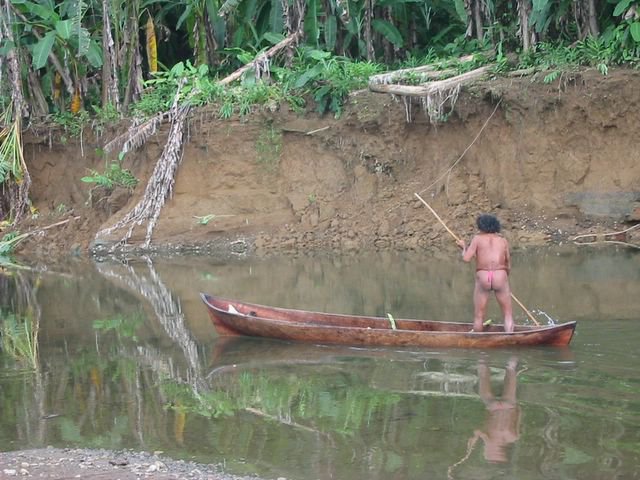
They had it even before we knew what was happening. My rod bowed in prayer to something below the tea-colored water’s surface. The six-pound test line danced like a cat on a hot pavement. All hell had broken loose. Beads of sweat rolled down Doris' back. Her clothes were now a second skin, clinging to her every move. We panted for breath. We had fish on. The silvery oval-shaped body and red belly of a Piranha broke the surface. I reached for it. "Don't let a finger get near their mouths or you'll lose it", our native Noanama Indian guide barked.

Minutes earlier, I shuddered from a breeze escaping from somewhere up ahead despite 90 degree-plus heat. The double-digit humidity didn't help either. A maddening buzz filled my ears, but thanks my coating of Vick's Vapor Rub, the blood-suckers wouldn't feast on me, I hoped. My eyes burned. My nose dripped. A coffee-table-sized leaf or hanging branch slapped into me every few steps. Curses burst from my lips even with my best efforts to "become as one" with the rainforest, as the Noanama had.

Tambaqui and Piraracu

Our fishing rods extended from 18" to five and a half feet. I'd hoped the light mono would suffice, although I'd squirreled away spools of twelve and twenty pound test as an afterthought. If we tagged into a 50-plus pound Tambaqui even that wouldn’t be enough. Don't even think about trying to handle a massive Piraracu that reach the size of a man in Brazil's uncherted Amazon River basin tributaries. Vines as thick as my wrist dipped into light coffee-colored waters making little ripples as it slid past roots and fallen branches. Tangled growth matted the gentle slope of the bank into tea-with-milk colored wetness. I’d flicked a thumbnail-sized chunk of bloody chicken liver on a barb-less hook with a split shot into a dinner plate-sized swirl just beside a snarl of mangrove roots jutting upwards through the surface.

Minutes later, his tanned skin gleaming with moisture, our guide demonstrated the efficiency of the scissor-like teeth. A green leaf held near the gaping mouth instantly sported a neat, crescent-shaped bite. Three heavy blows to the head prepared the killer for cleaning. After cleaning, the Noanama made a series of diagonal cuts along each side of the fish. Into these he carefully rubbed a mixture of salt, garlic, and ground roots from a small gourd he carried. A simple shaved branch frame held the fish over a smoky fire of glowing coals. The firm toasted flesh tasted smooth and a bit earthy, like a seasoned and mellowed catfish. With a wink and a sly nod towards Doris he said. “Make these heads into soup and you will need many wives”. She glanced at me with a puzzled look. I just smiled.

Like a shark

Ranging through South America from Brazil to the lowlands of Peru, they also inhabit waters in Venezuela, Guyana, Colombia, Ecuador and Bolivia. In the Amazon and Rio Negro rivers of Brazil and the Orinoco River in Venezuela, no creature is safe from the Piranha’s razor-sharp teeth and powerful jaws. The serrated teeth fit together like scissors, enabling Piranha to cut the flesh from their prey. Like a shark, a Piranha’s teeth are replaceable, when one breaks off a new one grows in its place.

The Yagua Indians

The Yagua Indians of Peru often use the sharp edges between the teeth of a Piranha jawbone to sharpen the point of their blowgun darts. A fish that is dying or swimming erratically will be quickly attacked by a large school. Piranha will also attack without warning to defend their eggs and territory. A wounded animal that strays into the water will be stripped to the bone so quickly it seems almost to “dance” on the surface as it’s ravaged from beneath. A bird that falls into the water will be gone, feathers and all, in three minutes or less. A trapped fish struggling in a net will be chewed clean to the head in a matter of seconds. Attacks on large animals and humans are often dramatically portrayed, but are rare. In some regions Piranha are known as "donkey castrators".

A President Speaks

"They will rend and devour alive any wounded man or beast.” U.S. President Teddy Roosevelt said, adding, “Piranha are the most ferocious fish in the world." Piranha, also called Caribe or Piraya only furthered their fearsome mystique when Roosevelt encountered them during his exploits in 1914. There are about 35 known species of Piranha but only five species represent a danger to man. Species range from the Red-Belly Piranha (Pygocentrus nattereri) with its characteristic red belly to the largest of the carnivorous species, the Black Piranha with its demon-red eyes and a 17 and a half inch long dark body weighing up to ten pounds. It could remove a man’s hand in two or three bites.

Piranha Head Soup

Most species dine on fruit or seeds that fall into the water from overhanging trees. The fish are not always aggressive. Women wash clothes in knee-deep water where men spearfish while children bathe or swim in these same Piranha-infested waters without harm. Further adding to the Piranha’s mystique, Indian men with half a dozen wives and up to a score of children attribute their potency to Piranha-head soup, although no scientific justification for the soup’s potency exists as yet.

Fishing for Piranha

Piranhas are usually part of indigenous peoples diet in the areas where the fish are found. All you need to go Piranha fishing are lines with a metal leader next to the hook so the fish doesn't bite through the line, a supply of red, raw meat (worms or cut-up fish will do too) and a tiny bit of luck. Piranha swim in large schools and are attracted by both movement and blood. In May of 1999, hundreds of anglers armed with rods, reels, and raw steak flocked to the Brazilian town of Aracatuba near Sao Paolo for a one-Sunday piranha fishing tournament. The townspeople had declared open season on the flesh-eating fish, which had decimated other species in the local river. The prize for the tournament was an outboard motor. But “most fishermen were content to go home with plenty of the reputedly aphrodisiac piranha”, claimed then town spokesman Nelson Custidio.

A Taste You're Sure to Enjoy

Piranha, earning their notorious reputation by reportedly killing 1,200 head of cattle every year in Brazil, are some of the best eating in South America. Whatever name you call them and no matter where you try them, when cooked in a variety of ways, their firm light flesh with its smooth, slightly nutty flavor, is a taste you’re sure to enjoy.


Prof. Larry M. Lynch is an EFL Teacher Trainer, Intellectual Development Specialist, prolific writer, author and public speaker. He has written ESP, foreign language learning, English language teaching texts and hundreds of articles used in more than 100 countries. Get your FREE E-book, "If you Want to Teach English Abroad, Here's What You Need to Know" by requesting the title at: lynchlarrym@gmail.com Need a blogger or copywriter to promote your school, institution, service or business or an experienced writer and vibrant SEO content for your website, blog or newsletter? Then E-mail me for further information.


Friday, January 16, 2009

Why Experience Trumps Pieces of Paper - Reader Comments

Reader Comments Based on the Article Post "Are Some Certifications Overrated?"

Blogger Ms. Lucy said...

Great post. One of my duties as a language consultant and ESL/EAL specialist is hiring new teachers. You wouldn't believe the number of PhD applicants that come my way. That being said, thank goodness that's not all I base qualifications on- because frankly, I've hired fewer than I can even remember (and I've been doing this a long time). To teach, you either have it - or you don't. Personally, talent, skills and personality is what I look for in a good teacher. It doesn't matter how many degrees you have; if you can't interest and motivate...forget about it. Thanks for this very interesting post.

Posted by Ms. Lucy


Blogger Eric H. Roth said...

"Excellent primer on why experience trumps pieces of paper, but in the classroom!

Let me explain. Many educational institutions, especially in some places, remain paper-driven. Let me give a sad example. I currently teach English at an elite private university, but I couldn't get a teaching job in a California public school teaching English because I lack the right MA.

Expertise and experience, for many educational institutions, remain of limited use. Former President Clinton could not teach government, history, or social studies in California public schools. Academy Award winning actors can not teach theater in the schools. World class musicians can't teach music. It's utterly absurd.

"We learn to walk by stumbling", goes the Bulgarian proverb. Teachers, and students, learn by doing and making good mistakes. You nailed the problem with reading 500 books to become a recognized expert instead of just throwing yourself in and gaining experience.

The best teachers are often autotelic (self-directed), and share their passion for learning and model love of knowledge. Adding a PhD after your name doesn't magically translate into you a dynamic, quality English teacher.

As Ms.Lucy notes, "you either have it - or you don't."

Thursday, January 15, 2009

How to Use Three Potatoes, a Suitcase and a Stuffed Dummy for Bringing in the New Year


Three potatoes, a suitcase and a stuffed dummy?

Want to know hot to use three potatoes and a stuffed dummy for bringing in the New Year?

Well here’s the scoop.

During the latter part of December in Colombia and Ecuador, an effigy of the old year is stuffed with sawdust, wood chips, shredded paper and other flammables. The body is seeded with a few well-placed firecrackers as well. The head is often a papier-mâché mask not infrequently resembling a famous person, character or politician. Someone you’d just as soon be rid of is a runaway favorite, although witches, politicians, presidents, generals and mother-in-laws have the followings.

The life-sized effigy is placed in a prominent place like a doorway, window or even on a chair out in front of the house to await its fate. The practice even extends to stores, shops and businesses with many having effigies made up and placed outside in front – away from the merchandise of course. On the evening of December 31st, often sooner, the effigy is set ablaze amid much fanfare, shouting and wishes for the New Year. It burns rapidly taking the old year and its troubles with it. As the crackling flames, fueled by gasoline poured on the effigy, reach the firecrackers, the dummy is blown into flaming bits. There are so many burning on some streets in Quito and other towns in Ecuador it looks like a war zone. The stage is now set for a fresh, New Year.

Now Take Three Potatoes

This one’s easy, but odd. You take three potatoes; some people use five, peel one and then toss them all under the bed. Don’t look now – no peeking! Reach under the bed and feel around for them. Got ‘em? Okay pick one, still no peeking now! Take it out. If it’s the peeled one, then goodness and bounty will be yours for the New Year. If it’s not, well, better luck next year. Don’t laugh, my Mother-in-law does this! (but for goodness sakes, don’t tell her I told you!)

Happy New Year! … and get that suitcase out!

WHAT Suitcase?

Want to know what suitcase? Be sure to read “Happy New Year Latin Style: Unusual South American Customs for bringing in the New Year”.


Prof. Larry M. Lynch is an EFL Teacher Trainer, Intellectual Development Specialist, prolific writer, author and public speaker. He has written ESP, foreign language learning, English language teaching texts and hundreds of articles used in more than 100 countries. Get your FREE E-book, "If you Want to Teach English Abroad, Here's What You Need to Know" by requesting the title at: lynchlarrym@gmail.com Need a blogger or copywriter to promote your school, institution, service or business or an experienced writer and vibrant SEO content for your website, blog or newsletter? Then E-mail me for further information.


Monday, January 12, 2009

Happy New Year Latin Style: Unusual South American Customs for bringing in the New Year


Teach English as a Foreign Language Abroad

When you teach English abroad you have a continual stream of opportunities to delve into and involve yourself into the local culture. It's one of the many payoffs of living and teaching English as a foreign language in another country. Take this case in point:

Question: What do a suitcase, 12 grapes, a sheaf of wheat, the color yellow, three potatoes and a stuffed dummy all have in common? Right! They each represent a custom for bringing in the New Year. But do you know these customs and how they’re celebrated?

Get That Suitcase Out

Many South Americans believe that if you carry an empty suitcase around the block on New Year’s Day you will be fortunate to travel during the course of the year. When my elderly neighbor sauntered out of her front gate in Cali, Colombia with a beat-up valise she’d dusted off for the occasion, she brushed off my queries brusquely.

“Don’t bother me now! I’m leaving!”

Minutes later, her “tour” complete, she confided her desires to “see the states” this year. According to her, a voyage this year was now, “in the bag”.

Around the middle of December you begin to notice a disproportionately large number of fruit and vegetable street vendors starting to sell grapes. Grapes are everywhere by Christmas. Green grapes, purple grapes, mixed grapes – they roll down the street and squish beneath your careless feet as you stroll market areas and shopping districts. Eating 12 grapes at or near midnight of New Year’s Eve will bring you good luck throughout the New Year. Green grapes are preferred by the majority, but any will suffice I was told by Anna Lucia who walked into the room with a bag of mixed grapes ample enough to produce a case of “vino”.

“You’re not planning to eat all those, are you?” I chided.

“No, they’re not just for me. They’re for my family too.”

I remembered that she and her husband have five children. Add in the extended family and well, enough said. Haven’t had your twelve yet? Hurry up, there’s still time.

A Bundled Sheaf of Wheat

A black youth stood on a downtown Pasto, Colombia corner hovering over a five-gallon bucket full of bundled sheaves of wheat. Each was wrapped with a brightly colored ribbon or two. Some were enhanced even further with a flower or small bouquet. People up and down the streets walked with a similar-looking sheaf held upright out in front of them like a siren in front of a fire engine. Crossing the Zocalo, or main square downtown, a young girl sitting on a park bench waved her sheaf at us like a magic wand. (pictured above)

“That’s a new one on me”, I said to my companion when she explained.

“If you hang a bundled sheaf of wheat in your home it’s very good luck.”

She continued, “It has twelve stalks of wheat in each bundle”.

“How much for one?” I asked the youth.

We quickly bargained to a lower price.

“Are you sure there’re twelve in here?” I questioned, not wanting to get short-changed.

“Oh yeah. Go ahead and count them.”

When my partner responded, “No there’re only eleven.”

He quickly snapped back, “No way! Count them again.”

We did and there were twelve. This New Year’s luck thing is serious business. The flowered sheaf stands guard now on the bookcase over my desk. Wish me luck, okay?

The Color Yellow

Not all mind you, but quite a few Latinos in Colombia and Ecuador use the color yellow for the New Year. There are a number of ways to do it. You can paint a room yellow. Place something yellow in the room. Wear a yellow item of clothing and you’ll shower yourself with fortune for the New Year. For reasons which as yet elude me, a favorite is to wear yellow underwear. (The preferred color in Mexico is red.) Both men and women have a pair or two on hand for the occasion – or so I’ve been repeatedly told. Okay, okay, I’ll fess up; I have a couple of pairs of yellow underwear myself. So call me fickle. I have red ones too. Do I wear a pair for New Year’s? I’ll never tell!

Be sure to read “How to Use Three Potatoes and a Stuffed Dummy for Bringing in the New Year” for more unusual Latin American New Year’s customs.

So again, “Happy New Year!” … now get that suitcase out!

Prof. Larry M. Lynch is an EFL Teacher Trainer, Intellectual Development Specialist, prolific writer, author and public speaker. He has written ESP, foreign language learning, English language teaching texts and hundreds of articles used in more than 100 countries. Get your FREE E-book, "If you Want to Teach English Abroad, Here's What You Need to Know" by requesting the title at: lynchlarrym@gmail.com Need a blogger or copywriter to promote your school, institution, service or business or an experienced writer and vibrant SEO content for your website, blog or newsletter? Then E-mail me for further information.